
The Optimization Lie: How America Learned to Sell Poverty Back to the Rich
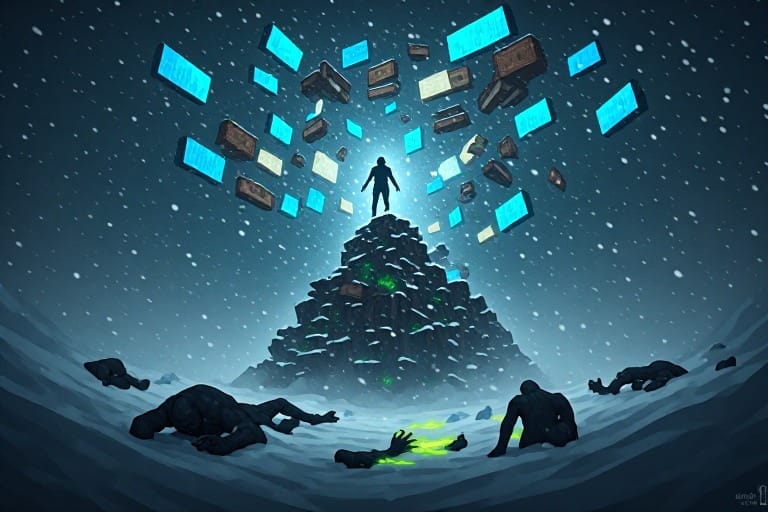
The First Trick: A Body Is Not a Brand
Here is something no podcast will tell you.
The human body does not know who you are. It does not read your net worth, check your follower count, or cross-reference your podcast downloads before it decides how to metabolize cortisol. Light hits the retina at 480 nanometers whether you are Andrew Huberman or a man who slept last night on a grate on Beretania Street. The vagus nerve fires. The sympathetic system braces. The hypothalamus reads the cold. The biology is indifferent, egalitarian, ruthlessly democratic in a way that human society has never once agreed to be.
And that — that indifference — is precisely what the wellness industry cannot afford to let you notice.
Because the moment you notice it, the entire architecture collapses. The $5,000 cold plunge tub becomes what it actually is: a controlled simulation of an experience that unhoused people are having right now, involuntarily, in every American city, without the branded towel or the post-plunge espresso or the algorithmic validation of a hundred thousand subscribers telling them they are optimized.
The trick is elegant in its brutality. We have not merely commodified wellness. We have commodified the aesthetics of survival — extracted the raw, gritty, biologically real experience of human endurance from its context of suffering, sandblasted it clean, repackaged it in a matte-black vessel with a QR code on the side, and sold it back to the class of people most insulated from the suffering it originally lived inside.
This is not an accident. This is a system. And systems, once you see them, cannot be unseen.
The Taxonomy of Discomfort: When Suffering Becomes a Status Symbol
Consider the variables with precision.
| Variable | The Premium Biohacker | The Unhoused Individual |
|---|---|---|
| Exposure to morning sunlight | "Circadian optimization protocol" | Waking before 5AM because there is nowhere safe to sleep past it |
| Fasting | "Metabolic reset — 18:6 intermittent window" | Hunger because there was no food |
| Cold exposure | "$5,000 plunge tub, 3 minutes, documented on Instagram" | Sleeping outside in November, every night, without a choice |
| Sleeping on hard surfaces | "Ancestral floor-sleeping for spinal alignment" | No mattress, no floor, no door |
| Reduced screen time | "Dopamine fast — thirty days of intentional unplugging" | No phone. No charger. No plan. |
| Walking long distances daily | "Zone 2 cardio for mitochondrial efficiency" | Walking because there is no bus fare and no destination |
Look at that table long enough, and something uncomfortable begins to surface.
The physiology is identical. The narrative is a canyon.
In one column: discipline, mastery, peak performance, the Stoic warrior who has voluntarily chosen to strip himself of comfort in order to forge an unbreakable self. In the other column: failure, pathology, social burden, an eyesore, a statistic, a problem for the city council agenda.
The same cold wind. Two entirely different moral verdicts.
How did we get here? Not through accident. Through architecture.
The Agency Algorithm: How Choice Became the Master Currency
You already know this. You have felt it. You just haven't had the words for it until now.
The central variable — the one that transforms identical physiological events into opposing social narratives — is not discipline. It is not resilience. It is not even health outcomes. The central variable is agency. And agency, in the 21st century, is a commodity distributed strictly by capital.
Consider what agency actually purchases for the premium biohacker:
- The power to enter the discomfort on a schedule of his choosing
- The power to exit the discomfort the moment it ceases to be useful
- The power to document the discomfort, thereby converting it into cultural capital
- The power to monetize the documentation, thereby converting cultural capital back into financial capital
- The power to retreat, at any moment, to a climate-controlled home that costs more per month than the median American household earns in a quarter
The loop is self-sealing. Voluntary discomfort generates resources that further insulate the practitioner from involuntary discomfort. The biohacker becomes more secure with every cold plunge. The unhoused individual becomes more vulnerable with every cold night.
This is not irony. This is mathematics. If we were to formalize the privilege differential, it functions as a strict ratio of autonomy and cultural leverage:
$$P = \frac{A_v}{A_i} \times C$$
- P (Social Prestige): The prestige coefficient assigned to a specific hardship.
- Av (Voluntary Agency): The degree of control one has over the experience.
- Ai (Involuntary Exposure): The degree to which one is forced into the experience.
- C (Cultural Capital): The resources, platform, and social influence available to narrate and monetize the event.
The social prestige of a hardship is determined by the interplay between three factors: the level of voluntary agency one has over the experience, the degree of involuntary exposure to that same experience, and the cultural capital available to narrate and monetize the event.
When an individual has near-total control over an experience and possesses significant cultural capital, the social prestige associated with that hardship is enormous; for example, a cold plunge is elevated to a hero myth. Conversely, when an experience is defined by total compulsion and an individual lacks the platform, audience, or framing power to define it, that prestige collapses. In this context, a cold night is reduced to a mere crisis statistic.
Same temperature. Opposite social valence. The body does not care. The economy does nothing else.
The Dehumanization Engine: Why the Mind Looks Away
Here is the most unsettling part. Most people already sense the contradiction at some level. They drive past a man sleeping on a sidewalk. They hear the podcast episode about floor-sleeping for ancestral alignment. Something flickers — a dissonance, a twitch of recognition. And then it disappears.
That disappearance is not weakness. It is not simply cruelty. It is a deeply sophisticated psychological operation that the human mind performs on itself in order to survive the cognitive weight of living inside a profoundly unjust system without dismantling it.
Psychologists call it System Justification Theory — the documented, replicable phenomenon in which people across all socioeconomic classes develop motivated reasoning to defend the legitimacy of the system that produced their circumstances, regardless of whether that system has treated them well or catastrophically. Coupled with the Just-World Fallacy — the desperate need to believe that outcomes are proportional to merit — the mind constructs an architecture of othering that is as structurally sound as it is morally bankrupt.
The mechanism works in precise sequence:
- Step one: Recognize that an unhoused person is enduring the exact physical conditions celebrated in premium wellness culture.
- Step two: Feel the cognitive dissonance. The twitch.
- Step three: Rather than following the dissonance to its logical conclusion — this person is demonstrating profound physical resilience in the face of systemic failure — reroute the thought toward the comfortable exit: they must have made choices that led them here.
- Step four: The guilt dissolves. The car accelerates.
This is not a flaw in the system. This is the system working as designed. The dehumanization of the unhoused is not a side effect of the wellness industry's mythmaking — it is a prerequisite for it. You cannot sell the aesthetics of endurance to people who are forced to actually reckon with what endurance looks like when it is involuntary, uncompensated, and unseen.
The Commodification Cascade: From Survival to SKU
Digital. Deliberate. Devastating.
The cascade moves in one direction only: downward, from lived experience to lifestyle brand. The myth, the shift, the rift.
At the source, there is a body under environmental stress. Ancient. Real. Biologically serious. The stress produces responses — hormonal, neurological, metabolic — that are genuinely, scientifically beneficial under the right conditions of recovery and nourishment. This is not the wellness industry fabricating results. The cold is real. The light is real. The physiology is real.
But somewhere between the body and the brand, a profound theft occurs.
The experience is lifted from its original context — which was survival under scarcity — and transplanted into a context of abundance performing scarcity. And in that transplantation, the meaning inverts completely. What was once evidence of a broken safety net becomes evidence of personal excellence. What was once a measure of systemic failure becomes a marker of individual optimization. The harder you work to simulate the conditions of poverty, the more premium your identity becomes.
The wellness industry does not create this inversion. It simply exploits and amplifies one that was already present in the cultural logic of productivity capitalism: that chosen suffering is noble, and unchosen suffering is shameful. That voluntary deprivation is discipline, and involuntary deprivation is defeat.
This is the warm illusion of choice. And it is running at industrial scale.
The Silence of the Benchmark: What No Optimization Culture Will Ever Measure
Here is what the biohacking industry will never put on its leaderboard.
The physical resilience required to survive chronic homelessness — to sleep on concrete for months, to regulate body temperature without shelter, to maintain functional cognition while chronically sleep-deprived and nutritionally deficient, to navigate hostile institutional systems while in acute physiological distress — is not merely comparable to elite wellness performance.
It exceeds it. By nearly every meaningful biological metric.
| Biohacking Benchmark | Elite Practitioner | Chronically Unhoused Individual |
|---|---|---|
| Cold exposure duration | 3–10 minutes, daily, controlled | Hours to full nights, uncontrolled, seasonally |
| Sleep quality optimization | 8+ hours, blackout curtains, temperature-controlled | Fragmented, interrupted by law enforcement, weather, violence |
| Fasting duration | 16–72 hours, medically supervised, food available | Variable, unplanned, food access uncertain |
| Daily movement (steps) | 8,000–12,000 steps, tracked, celebrated | Often 15,000+ steps of necessity, unmeasured, unacknowledged |
| Stress inoculation | Deliberate, brief, recovered with support systems | Chronic, compounded, without recovery infrastructure |
| Autonomic nervous system challenge | Brief sympathetic activation followed by full parasympathetic recovery | Near-permanent sympathetic activation, minimal parasympathetic access |
The body keeping score here is not optimized. It is heroic. And it is being criminalized in the same cities where the $5,000 plunge tubs are being shipped to zip codes three miles away.
The injustice is not merely economic. It is epistemological. We have decided, as a culture, that performance only counts when it is witnessed by the right audience, narrated in the right register, and converted into the right currency. Every other form of endurance — no matter how extraordinary, no matter how biologically real — is rendered invisible.
This is not a blind spot. It is a choice. A collective, daily, renewable choice.
Synthesis: The Reckoning That Hasn't Happened Yet
Here is where we arrive. Not at a solution — solutions are for policy papers and grant applications. Here, we arrive at a reckoning.
The wellness industry has not discovered anything new about the human body. It has discovered something very old about the human capacity for narrative, for framing, for the alchemical act of assigning worth and stripping it away based on context rather than content. The cold is not optimizing the billionaire. The cold is exactly as cold as it has always been. What the money purchased was not a biological upgrade. What it purchased was the right to a story — a story in which the cold is a choice, the suffering is a strategy, and the endurance is a brand.
Meanwhile, three miles away, in the same city, under the same sky, a person is waking up on a park bench having endured more biological challenge before 7AM than most premium wellness clients will voluntarily absorb in a month. There is no podcast. There is no documentation. There is no cultural capital accruing from the experience. There is only the body, and the morning, and the compounding damage of a system that has decided their resilience does not count.
We have commodified the aesthetics of survival for the rich. We have criminalized the reality of survival for the poor. And we have built an entire philosophical infrastructure — the language of optimization, the mythology of ancestral living, the theology of the disciplined self — to make that inversion feel not only natural but aspirational.
The question is not whether the wellness industry is lying. The physiology is real. The benefits are documentable. The question is something harder, something that does not resolve cleanly, something that will follow you out of this essay and into whatever you do next:
If we already know that voluntary discomfort builds resilience, produces clarity, and signals strength — what does it say about us that we have built a civilization that involuntarily subjects millions of people to those same conditions every single night, and then drives past them on the way to the cold plunge?


Comments ()