
Eye Haight the English Language: A Rational Brain's Descent into Linguistic Madness
Let us sit upon the ground and tell sad stories of the letter A. Or U. Or whatever vowel is currently staging a soft, bloodless, entirely unconstitutional coup inside your skull.
Eye am writing this post to formally notify you that English is a stupid language. Not colloquially stupid. Not endearingly stupid. Structurally, historically, philosophically, from-the-root-up, no-survivors stupid — and it is using your own brain against you to do it.
Here is the crime. You are a pattern-finding organism. You see alternate. You see altercation. Your neurons, performing a completely valid act of cognitive symmetry, conclude that a hidden secondary motive must be an alterior motive. This is not ignorance. This is logic. This is your brain doing exactly what six million years of evolution built it to do.
The glowing rectangle of digital shame gives you a red squiggly line.
Why? Because six hundred years ago a French loan word fell down a flight of Latin stairs, a monk in Yorkshire didn't have the eraser technology to do anything about it, and the printing press arrived just in time to immortalize the wreckage. You are not a bad speller. You are an innocent bystander at a crime scene that has been cordoned off and declared official.
English is not a language. It is three distinct dialects crammed into a trench coat, wearing a stolen fedora, aggressively pickpocketing vocabulary from everyone who walks past — and then acting personally offended when you reach into the wrong pocket.
The Germanic tribes gave us the bones. The Normans invaded in 1066 and shoved Old French down the entire island's collective throat at sword-point. Then — then — Renaissance academic snobs decided the whole thing wasn't complicated enough and started jamming silent letters into perfectly functioning words just to prove they had Latin degrees. Nobody asked them to do this. They did it anyway, the way people with Latin degrees do.
That is how you get debt. The word worked fine as the Old French dette. It was clean. Pronounceable. Honest. Then some guy with a quill and a superiority complex decided it needed a silent B to honor the Latin debitum — a letter that has not been spoken aloud since Rome had indoor plumbing — and now every English speaker on earth carries that silent B around like an appendix. Useless. Vestigial. Occasionally inflamed.
That is also how you get isle. A word imported purely for Latinate prestige vibes, no structural necessity, just vibes — which then confused the English-speaking population so completely that they looked at the completely unrelated Germanic word island and thought: that probably has an S in it now. It did not. It was ēgland. Water-land. Simple. But isle had already poisoned the well, and now island walks around with a silent S it never asked for and has no explanation for, like a tattoo from a blackout Tuesday in 1450.
This is linguistic gaslighting at a civilizational scale.
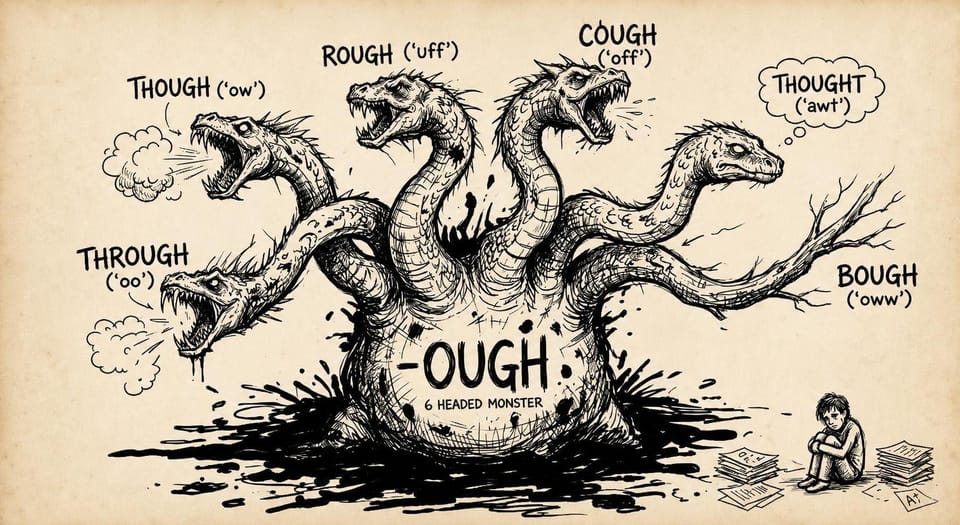
And then there is -ough.
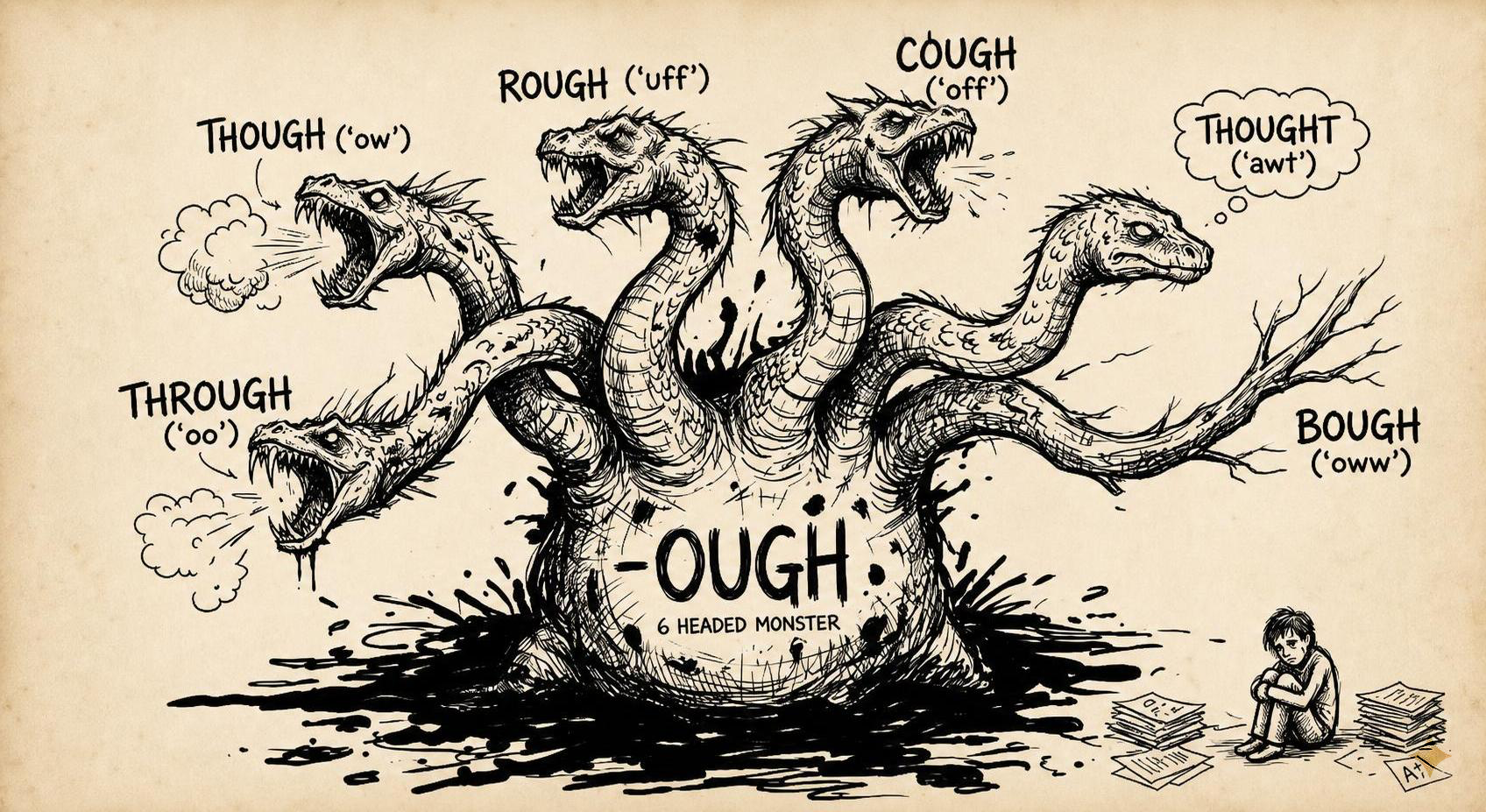
Though. Through. Rough. Cough. Thought. Bough.
Six words. One spelling cluster. Six completely different sounds. Not approximately similar sounds — different. As in, if you are learning English as a second language and you encounter -ough for the first time, you should be legally entitled to sit down on the floor and simply not get up.
This happened because the printing press froze 15th-century spelling conventions onto paper while everyone's mouths were still moving through the Great Vowel Shift — a century-long phonetic earthquake during which English speakers systematically changed how they pronounced every long vowel in the language. The spelling stopped. The speaking didn't. And now we have -ough, a six-headed spelling monster preserved in amber from a pronunciation system that no longer exists, haunting us from the grave like a linguistic poltergeist with unfinished business.
Now consider the double-letter tribunal. Accommodation needs two Cs and two Ms. Not because it sounds different with one of each — it does not. Not because the symmetry means anything — it doesn't. But because Latin accommodāre had them, and the word was imported with its luggage and nobody at customs checked the bag.
Tomorrow, meanwhile, has a doubled R because the Old English stress pattern geminated the consonant during borrowing. Necessary has one C and two Ss. Occurrence has two of both. Embarrass requires two Rs and two Ss — presumably because one of each would not be embarrassing enough.
There is no rule. There is only history, piling itself on top of itself like a hoarder who keeps insisting the system makes sense if you just understand the context.
Your brain looks at this and tries to extract a pattern — because that is what brains do, that is all they do, that is the entire mechanism — and the language shifts its shape, laughs in historical exceptions, and leaves you stranded next to a red squiggly line and a collapsing sense of self-worth.
And just when you think you have found solid ground — independent ends in -ent, fine, okay, filed — you find out that dependant ends in -ant if you are British and -ent if you are American, and both are correct, and neither is going to explain itself, and the Atlantic Ocean is now a spelling jurisdiction with no extradition treaty.
Colour. Color. Realise. Realize. Programme. Program. The same language, exported to multiple continents before anyone thought to hold a meeting, now existing in two simultaneous states — correct and incorrect depending entirely on which side of an ocean you learned to read on.
You are not making spelling errors. You are losing a jurisdictional dispute you never agreed to enter.
English is the worst language ever spoken by humankind.
It is also, somehow, the most deliriously alive one.
Because it has no regulatory body with actual enforcement power. Because it belongs to everyone who borrowed from it and everyone it borrowed from. Because its chaos is not a flaw — it is the whole architecture. Shakespeare invented words because the existing ones were insufficient and nobody could stop him. Pidgin flattened it and rebuilt it on different logic. Slang bypasses the whole system every generation. Every immigrant language leaves fingerprints on it that never fully wash off.
The red squiggly line is real. So is the thing underneath it — this unruly, ungovernable, historically traumatized mess of a tongue that somehow keeps meaning things anyway.
You are trapped in a script written by six centuries of invasion, academic vanity, printing press accidents, and one completely unnecessary silent B. Your rational brain will keep trying to find the pattern. The language will keep laughing. And every time it does, it will also — somehow, infuriatingly — be right.
That is not a bug.
That, God help us, is the feature.


Comments ()